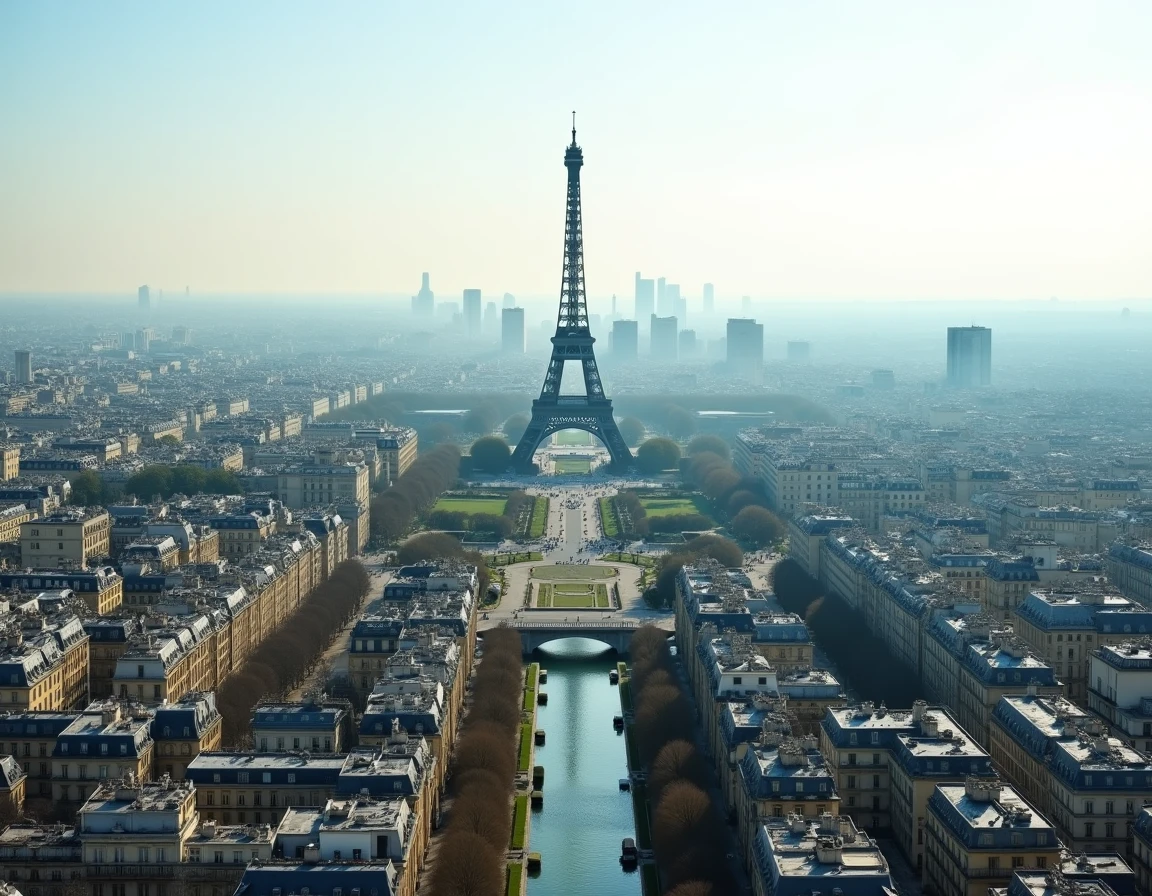
Comparing the size of Paris and London amounts to measuring two urban realities built on very different administrative divisions. The often-cited figure (London is said to be fifteen times larger than Paris) is based on a comparison of perimeters that do not correspond. To clarify, one must establish the correct scales of comparison and then examine what these differences in area produce in terms of density and urban functioning.
Why the “fifteen times” ratio between Paris and London is misleading
The city of Paris covers 105.4 km². Greater London, on the other hand, spans 1,572 km². The ratio seems spectacular, but it pits two entities of different natures against each other.
Intra-muros Paris is a unique municipality, inheriting a perimeter that has been fixed since the annexation of neighboring municipalities in the mid-19th century. Greater London, created in 1965, encompasses 33 boroughs and functions more like a metropolitan region with its own government. The City of London, the historical and financial core, covers only about 3 km², which is thirty-five times less than the municipality of Paris.
Any comparison of the size of Paris and London must therefore specify the perimeter used; otherwise, the result lacks analytical value.

Area of Paris and London according to three compared perimeters
The table below compares the two cities at three scales: the historical administrative core, the metropolitan governance entity, and the functional metropolitan area.
| Perimeter | Paris | London |
|---|---|---|
| Historical core (City / municipality) | 105.4 km² | ~3 km² (City of London) |
| Metropolitan governance entity | 814 km² (Metropolis of Greater Paris) | 1,572 km² (Greater London) |
| Functional metropolitan area | Not directly comparable (Île-de-France region: ~12,000 km²) | ~8,917 km² |
At the level of governance entities, the gap narrows considerably: Greater London is about twice as large as the Metropolis of Greater Paris, not fifteen times. At the scale of the metropolitan area, the Île-de-France region even exceeds the London functional area in gross area.
Population density: Intra-muros Paris far ahead of London
Area only makes sense when related to the population it accommodates. And this is where the roles reverse.
Paris has a density of about 21,000 inhabitants per km², compared to around 5,640 inhabitants per km² for Greater London. The ratio is almost one to four. This extreme concentration is explained by the Haussmannian legacy: six to seven-story buildings, narrow streets, and a near absence of single-family homes in the central fabric.
London, on the other hand, incorporates vast suburban areas, royal parks, and river valleys within its 1,572 km². The density varies greatly from borough to borough: central boroughs (Westminster, Camden) reach levels close to certain Parisian arrondissements, while peripheral districts (Bromley, Havering) maintain a semi-rural character.
- Paris concentrates its population on a compact territory, generating some of the highest land pressure in Europe
- London spreads its inhabitants over a much larger territory, with considerable density differences between the center and the periphery
- The Metropolis of Greater Paris (814 km², 7.1 million inhabitants) offers a more relevant point of comparison with Greater London (1,572 km², approximately 8.8 million inhabitants)
Metropolitan area of Paris and London: Greater Paris changes the game
The territorial reform of Greater Paris is gradually bringing the Parisian institutional structure closer to that of Greater London. This evolution makes comparisons based solely on the 105 km² municipality increasingly obsolete.
The Metropolis of Greater Paris, created in 2016, includes Paris and 130 neighboring municipalities. Its perimeter of 814 km² remains smaller than that of Greater London, but the functioning is similar: inter-municipal governance, large-scale urban planning, and service sharing.

If we further expand the framework to the Île-de-France region, the area far exceeds that of the London metropolitan area. However, Île-de-France includes extensive agricultural and forested areas that have no equivalent in the London perimeter used by international statistics. The choice of perimeter determines the outcome of the comparison.
Area and transport: what size changes in daily life
The difference in area between the two metropolises has direct consequences on commuting. The Paris metro network, designed to serve a compact territory, has 16 lines on a dense grid. The London network (Tube and Overground) covers a much larger territory, with a fare zone system (1 to 6) that reflects the geographical dispersion of the city.
An average commute in London is significantly longer than in Paris, partly because the distances to be traveled are greater. Projects to extend the Paris network (Grand Paris Express) aim precisely to open up the inner suburbs and bring travel times closer to those of the London network over a comparable perimeter.
- The Paris metro concentrates its stations over 105 km², with one of the highest station densities in the world
- The London Tube serves a perimeter ten times larger, with significantly greater intervals between stations in the periphery
- The Grand Paris Express will add approximately 200 km of automatic lines around Paris, changing the very perception of the size of the metropolis
The question of which city is larger does not have a single answer. London is larger than Paris at every scale of comparison, but the gap varies from a factor of fifteen to a factor of two depending on the perimeter used.
Paris compensates for its compactness with an unmatched density in Western Europe. The real dividing line between the two capitals does not lie in gross area, but in how each organizes its inhabitants, transportation, and activities across the territory it has.