Garden rainwater drainage is based on a simple principle: direct, slow down or store runoff so it does not cause standing water or damage to foundations. On clay soil or after several days of rain, a single solution is generally not enough. Combining storage, drainage and infiltration helps keep the system working even when the tank overflows and the soil is waterlogged.
1. Rainwater harvesting
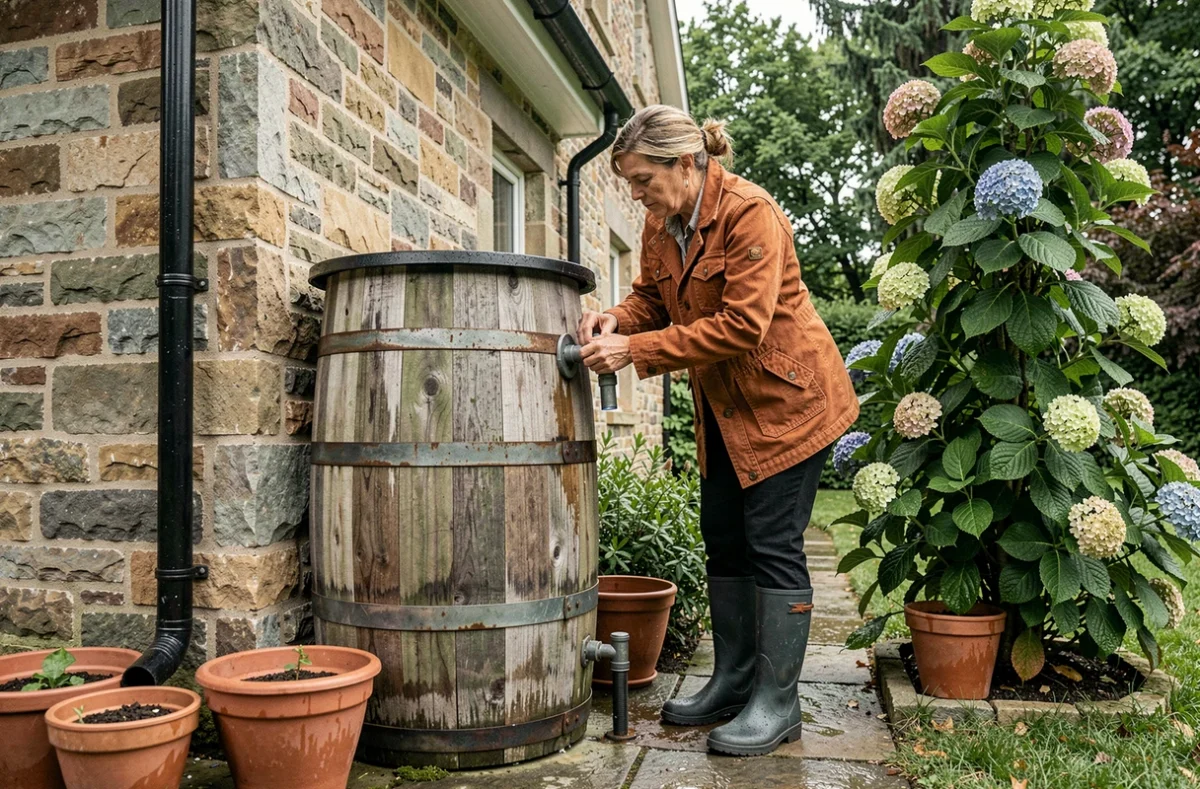
Rainwater harvesting involves collecting water from rooftops via gutters and storing it in an above-ground or underground tank. The water can then be used for watering, outdoor cleaning or, subject to certain conditions, some household uses.
Since 1 September 2024, the regulatory framework has been based on the decree and order of 12 July 2024, which replace the 2008 order. No declaration is required for a tank used solely for outdoor watering. Indoor uses (toilet flushing, floor cleaning), however, involve specific procedures and health requirements.
One often-overlooked point: the tank overflow must be directed to a suitable outlet, such as an infiltration area or a drain. Otherwise, excess water flows over the surface and causes erosion near the foundations.
A tank only reduces runoff if it has capacity available when it rains—that is, if the stored water is actually used between rainfall events. Local requirements may also call for a combination of a tank, infiltration and controlled discharge to drain rainwater from the garden in compliance with regulations.
Another useful distinction: during droughts, watering restrictions do not apply uniformly to stored water. There is no single national rule. Depending on the local prefectural order, stored rainwater may be exempt or subject to specific watering times.
2. Drainage channels and gutters
Drainage channels and gutters are the first link in the drainage chain. Their role is to collect surface water (from patios, driveways or downpipes) and direct it to a collection point or outlet.
A grated drainage channel installed across a concrete driveway intercepts runoff before it reaches the lawn or house. Even a slight gradient determines how effectively the system works. Without sufficient slope, water will stagnate in the channel itself.
Maintenance makes all the difference: gutters clogged with leaves can overflow within minutes during a heavy downpour, sending water straight to the base of the walls. Seasonal cleaning and downpipe guards reduce this risk. Drainage channels, meanwhile, need regular cleaning to prevent sediment from building up.
3. Drains and drainage systems
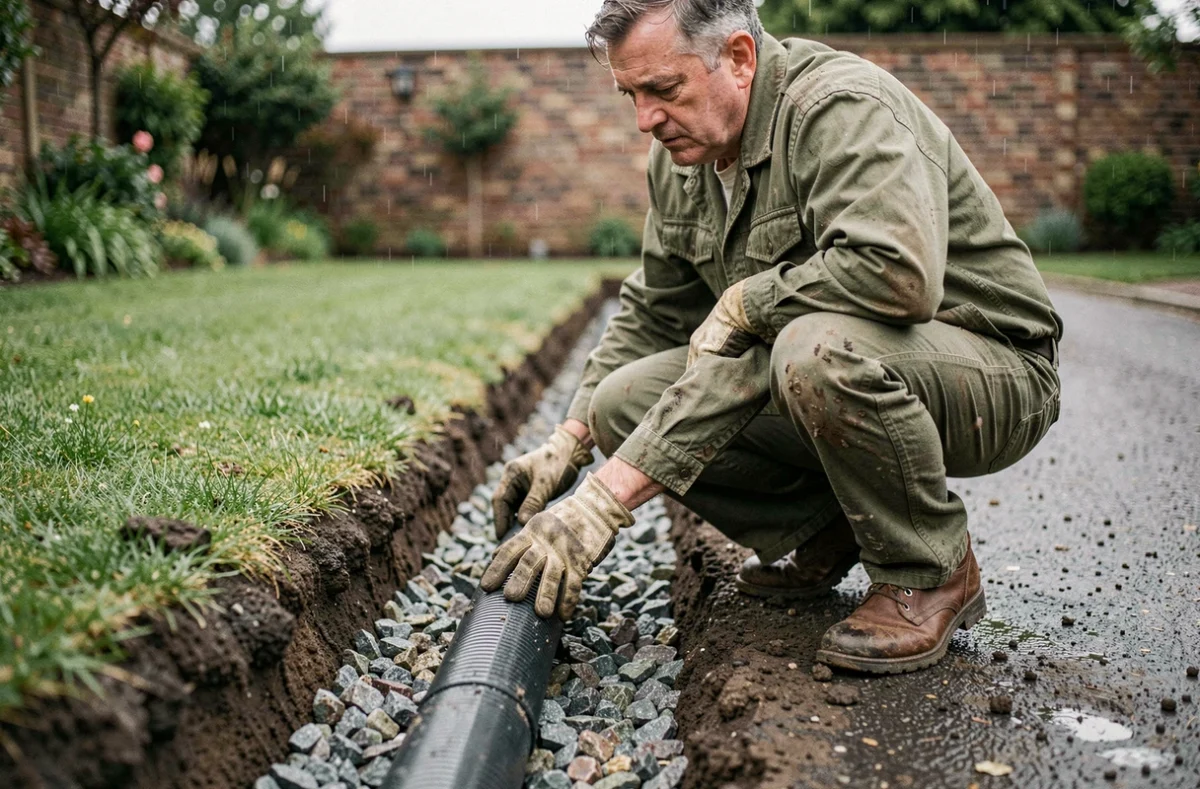
Underground drainage removes water that accumulates below the soil surface. An agricultural drain (a perforated pipe wrapped in geotextile and laid in a gravel-filled trench) collects groundwater and carries it to an outlet: a ditch, soakaway or stormwater network.
This system is particularly well suited to gently sloping ground where water collects at a low point. The drainage trench works by gravity, without a pump, provided the outlet is lower than the drain. On flat ground with no natural outlet, an infiltration well should be installed at the end of the system.
Sizing should not be based on a simple visual assessment of the soil. Measuring permeability and checking the depth of the water table can help prevent an incorrectly sized installation. A high water table or unstable subsoil can make infiltration at the end of the drain ineffective or even counterproductive.
4. Infiltration and soil permeability
Infiltration allows water to pass through the soil surface and reach deeper layers. There are two main approaches:
- Replace impermeable surfaces (smooth concrete, asphalt) with permeable paving: cellular paving grids, stabilized gravel or pavers with wide joints. Water passes between the joints or through the material instead of running off.
- Create sunken planted areas (swales, rain gardens) that temporarily collect water and allow it to seep slowly into the soil.
- Keep or restore grass strips alongside hard surfaces to absorb some of the runoff before it reaches low points.
The limitations of this approach become apparent on clay soils or after several days of continuous rain. When the soil is saturated, infiltration slows dramatically. That is why infiltration alone is not a complete system: it must be combined with storage (a tank or basin) or drainage to handle prolonged rainfall.
5. Underground networks and retention basins
Underground networks carry water collected by drainage channels, gutters or drains to a discharge point or temporary storage area. Buried PVC pipes connected to downpipes and drainage channels converge at a collection chamber before leading to the final outlet.
The retention basin is the final link in the system. Its purpose is to temporarily store a large volume of water, then release it at a controlled rate into the soil or drainage network. In a garden, this may take the form of an underground tank with flow control or a landscaped depression (a temporary pond).
This solution comes into its own when the other options reach their limits. After several days of rain, the rainwater tank is full, the saturated soil can no longer absorb water, and the drains are operating at full capacity. The retention basin takes in the excess and releases it gradually once the rainfall has passed.
- Sizing depends on the impermeable area of the property, the discharge rate permitted by the local authority and local rainfall levels.
- Some local authorities set a maximum discharge rate for each plot, making retention mandatory once the impermeable area exceeds a certain threshold.
- Maintenance involves cleaning the inspection chambers, checking the flow regulator and ensuring the geotextile is not clogged.
A reliable drainage system rarely relies on just one of these five solutions. Rainwater harvesting captures the initial rainfall, drainage channels direct the flow, drains manage groundwater, infiltration handles diffuse runoff, and retention basins cope with prolonged rainfall. It is the complete system that keeps a garden dry even after several days of rain.