
You send a text message, a delivery receipt appears on your screen, and you conclude that the message has indeed been read. This logic seems sound, but it is based on a technical confusion between two very different mechanisms. When a number is blocked, the behavior of these notifications varies depending on the protocol used by your phone, and the response is not the same for standard SMS as it is for rich messaging.
Network delivery receipt and read receipt: two distinct circuits
Before discussing blocking, it is essential to understand what your phone is actually showing you. A SMS delivery receipt confirms the delivery to the network, not the opening of the message. Specifically, when you enable delivery receipts in your Android or iOS messaging app, the operator notifies you that the message has been transmitted to the antenna managing the recipient’s line.
The read receipt, on the other hand, works differently. It requires the recipient to actually open the message in their app. This mechanism does not exist in standard SMS. It is reserved for rich protocols like RCS or iMessage, where the confirmation passes through the app itself and not through the operator’s network.
To better understand the relationship between delivery receipt and blocked SMS read, it is necessary to analyze each protocol separately, as their responses to blocking differ completely.
Standard SMS and blocking: why the delivery receipt can mislead you
Have you ever noticed that a delivery receipt appears while you suspect your correspondent has blocked you? This is normal, and it is precisely the trap.

In standard SMS (2G/3G/4G protocol without RCS), blocking occurs at the recipient’s phone, not at the network level. The message leaves your device, crosses your operator’s network, and then that of the recipient. The operator considers the SMS delivered as soon as it reaches the line.
The recipient’s phone filters the message after network receipt. The SMS technically arrives on the device, but the blacklist configured in Android or iOS intercepts it before it appears in the conversation. The result: you receive a delivery receipt, but the recipient sees nothing.
This operation creates a false sense of security. Here’s what actually happens:
- Your operator sends the SMS to the recipient’s network and confirms delivery with a delivery receipt
- The recipient’s phone receives the SMS at the system level, validating the delivery from the network side
- The blocking function (Android blacklist, iOS filter) deletes or hides the message before it is displayed in the messaging app
- No read receipt is generated since the standard SMS protocol does not handle this feature
A delivery receipt for SMS never proves that the message has been read. It only proves that the network has done its job of transmission.
RCS and iMessage: blocking cuts off all signals
The behavior changes radically with rich messaging. RCS (used by Google Messages on Android, and available on iPhone since iOS 18) and iMessage manage delivery and read receipts at the application level.
Why does this distinction matter? Because blocking in these protocols occurs before the application layer. When a contact blocks you on iMessage or in an RCS conversation, your message is not treated as received in the recipient’s conversation. The app therefore sends neither a delivery receipt nor a read receipt.
In practice, your message remains with a single check (sent) without ever changing to two checks (delivered). On iMessage, the bubble remains blue but without the “Delivered” mention below. This application silence is a much more reliable indicator than the behavior of standard SMS.
Apple confirmed with iOS 18 that RCS supports delivery and read receipts between compatible devices. This means that the complete absence of receipts in RCS suggests blocking or a technical issue, whereas the same absence in standard SMS means nothing particular.
Identifying SMS blocking based on the protocol used
The protocol used in your conversation completely changes the interpretation of the receipts. Here’s how to distinguish the situations:
- In standard SMS: the delivery receipt remains positive even in the case of blocking, and the read receipt does not exist. No reliable conclusion can be drawn from these notifications
- In RCS (Android): the absence of a delivery receipt after sending, combined with a message that remains in “sent” status without changing to “delivered,” may indicate blocking
- In iMessage (iPhone): the disappearance of the “Delivered” mention under the blue bubble, especially if it appeared before, constitutes a coherent signal of blocking
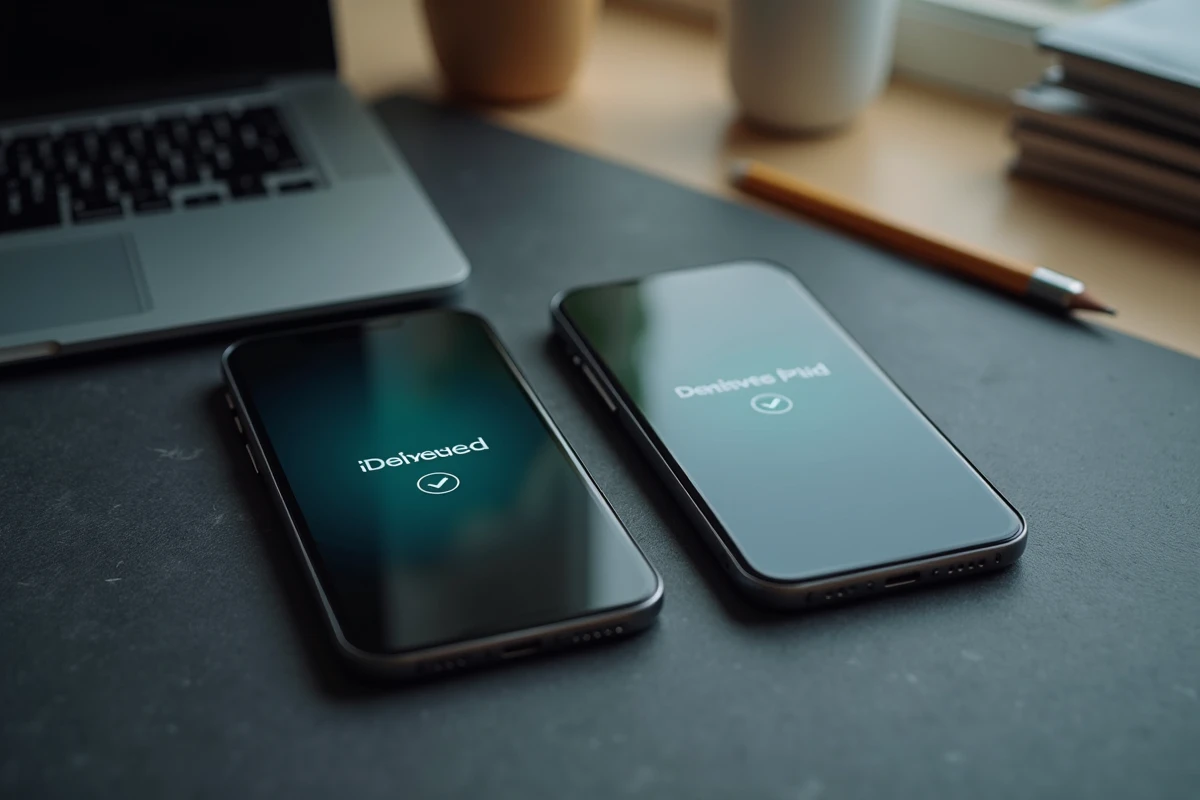
One detail complicates the analysis further: when the recipient’s data connection is inactive, RCS or iMessage may automatically switch to standard SMS. In this case, you revert to the behavior described above, with a network delivery receipt that says nothing about the actual reading.
When the protocol switches without warning
An RCS message can degrade to SMS without any visible notification. Your phone first attempts to send via RCS. If the recipient’s server does not respond within a defined timeframe, the message is sent as standard SMS. You then receive a network delivery receipt that no longer has the same meaning as the expected RCS receipt.
On iPhone, the same mechanism exists between iMessage and SMS. The bubble changes from blue to green, indicating that the message has been sent as SMS. Any potential delivery receipt then comes from the operator’s network and not from iMessage.
What delivery receipts do not allow you to conclude
Receiving a delivery receipt after sending an SMS to someone who has potentially blocked you neither confirms nor denies the blocking. Only the absence of a receipt in rich messaging constitutes an actionable clue, and even then, a phone that is turned off or out of network produces the same effect.
Phone blocking is designed to remain invisible to the sender. Operators do not report the filtering performed by the recipient’s device. Rich messaging apps provide a bit more information through their silence, but none will ever send you an explicit notification indicating that your contact has blocked you. This opacity is intentional: it pertains to the recipient’s privacy, who chooses to filter their communications without informing the other party.