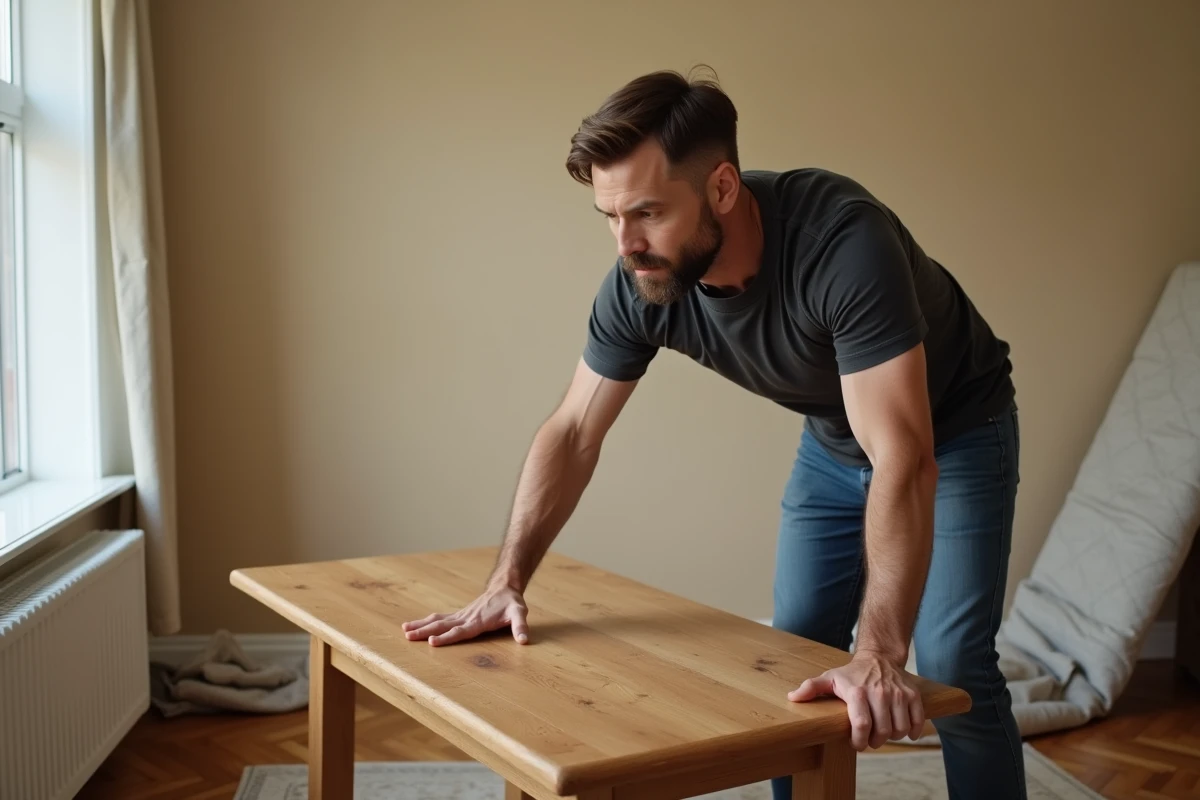
Turning a heavy table is not just a simple flick of the wrist. The difficulty lies less in the raw weight than in the bulkiness, the movement of the center of gravity during rotation, and the stresses on the joints. Here we detail the turning techniques that preserve both the furniture and the operator’s back.
Controlled tilting with intermediate supports: the safest method for turning a table
The direct rotation of a massive table is the most accident-prone action. The INRS recommends in its ED 987 sheet to transform the turning into a series of controlled tilts with intermediate supports (wedges, trestles, stable chests). The principle: never leave the load suspended freely between the starting position and the end position.
Specifically, place two trestles or a rigid support at mid-height along the edge of the table you are going to tilt. Rotate the table on an edge until it rests on the intermediate support, with the top almost vertical. Stabilize, reposition your hands, and then complete the rotation. This method halves the effort and eliminates the critical phase where the load abruptly changes axis.
For those looking for tips for lifting a heavy table before tilting it, the principle remains the same: break each movement into short and stable sequences.
Choice of supports and transition height
The intermediate support must be at least as wide as the depth of the table. An adjustable construction trestle is suitable for most configurations. If the table exceeds a hundred kilos, we recommend two support points spaced two-thirds of the length of the top, to avoid any excessive bending of the panel.
Force distribution and handling grips on a heavy table
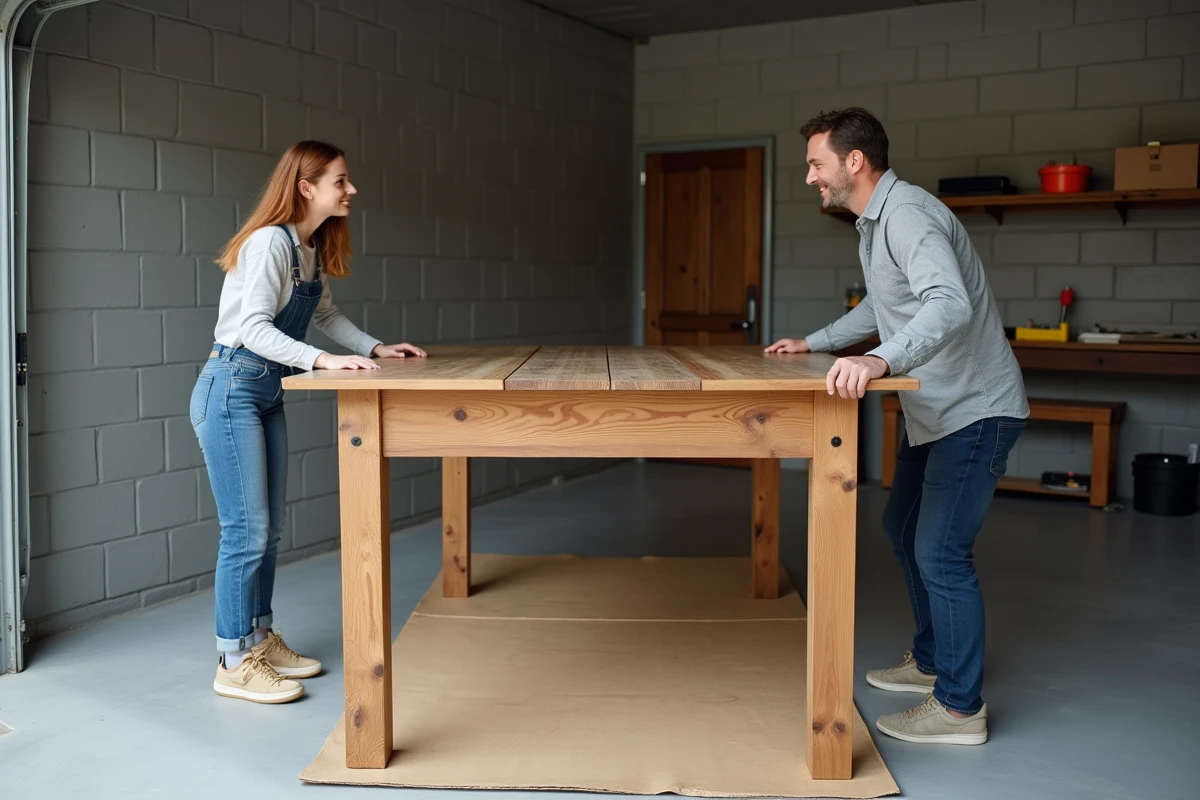
A table does not offer handles. The legs, crossbars, and frame reinforcements are the only reliable gripping points. Never grip a tabletop by the upper edge to initiate a tilt: the load slips as soon as the angle exceeds about fifteen degrees.
Work in pairs when the weight of the table exceeds twenty kilos. The INRS lowers the practical limit for manual handling of bulky loads because the distance between the body and the center of gravity increases the torque exerted on the lumbar spine.
- Grip the lower crossbars or legs, never the decorative elements (moldings, unlocked extensions).
- Keep your elbows close to your body and your knees bent during the initial lifting phase.
- Coordinate the tilt with a clear verbal signal: one operator guides, the other follows the movement without pulling in the opposite direction.
On a table with a central base (like a tulip foot or column), the center of gravity is high and narrow. Block the base with your foot on the ground during the tilt to prevent any lateral slipping.
Handling equipment suitable for turning furniture
Slippery pads and wheeled carts, often mentioned for moving, do not solve the problem of turning. Two categories of equipment really change the game.
Two-operator lifting straps
“Forearm forklift” type handling straps distribute the load across the forearms and free the hands to guide the rotation. They work particularly well on rectangular tables, where each operator can pass a strap under one end of the top and then assist the tilt in a synchronized manner.
Inflatable pads (airsled) for very heavy tables
For several years, manufacturers like Airsled have been marketing inflatable pads that create an air cushion under the feet of the furniture. They allow the table to “float” on a smooth floor (tiles, polished concrete, PVC) and to be repositioned without friction. The advantage for turning: once the table is tilted onto its intermediate support, the pads facilitate the final repositioning without pushing effort.
Protecting the floor and joints during turning
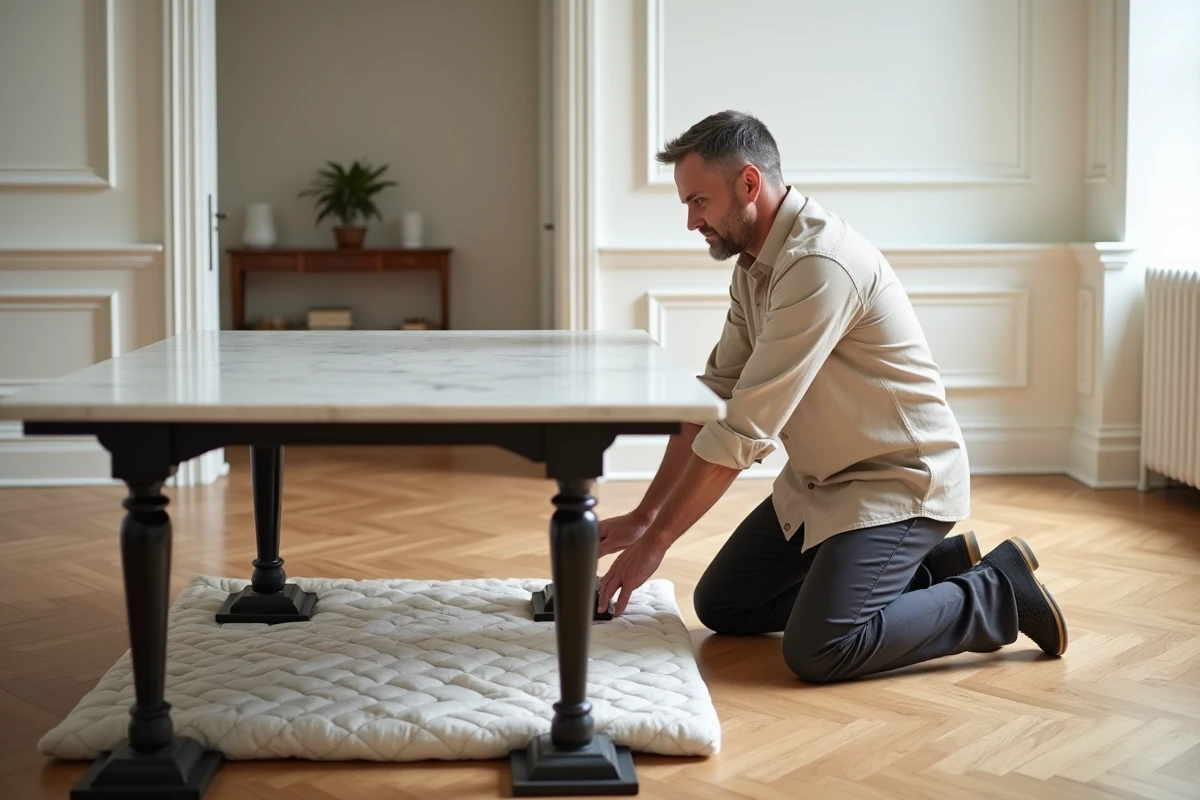
Turning is the moment when the table legs mark the floor and when the joints undergo the most stress. A thick moving blanket placed on the ground at the receiving spot absorbs the landing shock and prevents scratches on parquet or tiles.
Check the tightness of all fastening elements before starting. A loose screwed leg can come apart under the torsion effect during rotation. On extension tables, always remove them: they add unnecessary weight and risk opening during the maneuver.
- Place a thick cardboard or plywood sheet under the tilting area if the floor is fragile.
- On floating parquet, avoid any flat pivoting: the supporting leg concentrates a point pressure that can dent or scratch the plank.
- Protect the edges of the top with foam tape if the table needs to rest temporarily on its edge.
Special case of stone or glass tops
Tables with marble, granite, or tempered glass tops require separating the top from the base before any attempt to turn. The top is handled flat, resting on soft wedges, while the base is turned separately. Attempting to turn the whole as a single unit exposes the top to a clean break at the fixings.
Turning a heavy table boils down to one principle: break the rotation into stable steps. A good set of trestles, a protective blanket, and a coordinated pair are sufficient in the vast majority of cases. Inflatable pads or lifting straps provide additional comfort but do not replace the method of tilting with intermediate supports.